
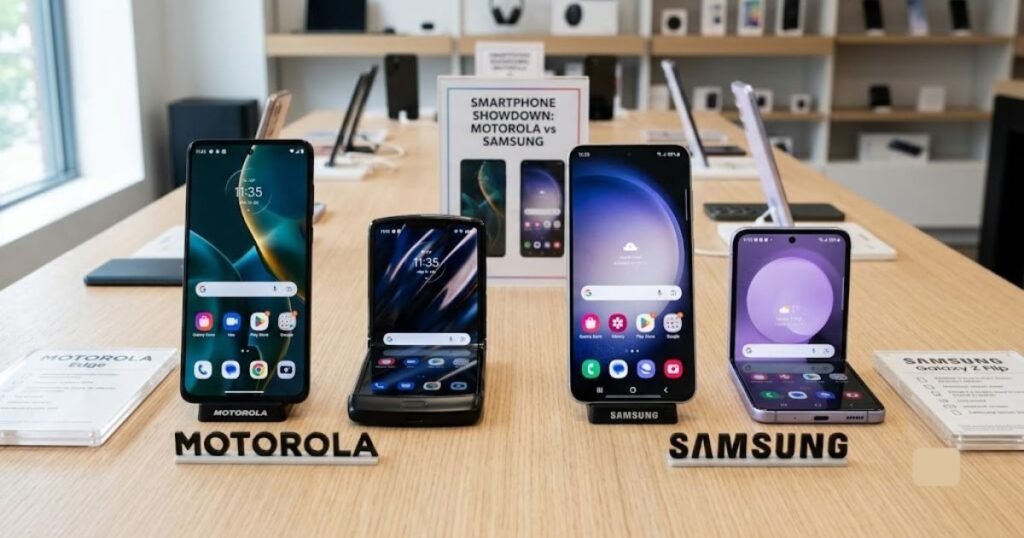
If you’re standing in a carrier store (or scrolling Amazon at midnight) trying to decide between a Motorola and a Samsung phone, you’re not alone. These two brands make up a huge share of the unlocked and carrier Android market in the US, but they’re built around very different philosophies.
Samsung pursues flagship performance, camera innovation, and one of the longest software support windows in the business. Motorola leans into clean, near-stock Android, genuinely long battery life, and prices that don’t make your wallet flinch.
Neither brand is “better” in every category, and that’s really the point of this guide. We tested, researched, and compared real-world usage patterns (not just spec sheets) across both lineups to help you figure out which one actually fits how you use your free phone.
Common Mistakes to Avoid When Choosing a Smartphone
- Buying on camera megapixels alone. A 200MP sensor doesn’t automatically outperform a well-tuned 50MP one — image processing matters more than raw resolution.
- Ignoring update policy. A cheaper phone that loses security support in three years can cost more over time than a slightly pricier phone that lasts six.
- Overbuying storage/RAM you won’t use. Most everyday users are fine with 128–256GB; heavy photographers and gamers should size up.
- Skipping the return/trade-in window. Both brands offer trade-in credit — check current promotions before you buy outright.
READ MORE: Top 5 Smartphones of 2026: Galaxy S25 Ultra vs iPhone 16 Pro Max
At a Glance: Motorola vs Samsung
| Feature | Motorola | Samsung |
| Price Range | $170 – $1,300 | $350 – $1,300+ |
| Camera | Good, best on Edge/Razr series | Excellent across the lineup |
| Battery | Frequently the stronger performer | Solid, but rarely class-leading |
| Performance | Mid-tier chips (MediaTek), flagship Snapdragon on Razr Ultra | Snapdragon 8 Elite (US models) top to bottom on flagships |
| Gaming | Capable, not built for it below Edge/Razr Ultra | Strong, especially S26 Ultra |
| Display | Bright OLED panels, competitive at every price | Bright, color-accurate Dynamic AMOLED |
| Software | Near-stock Android, useful Moto AI add-ons | One UI 8, deep Galaxy AI integration |
| AI Features | Moto AI: Catch Me Up, Magic Canvas | Galaxy AI: Circle to Search, Object Eraser, Now Brief |
| Updates | 2–3 years typical; 7 years on Motorola Signature line | 6–7 years across nearly the entire lineup |
| Build Quality | Good, vegan-leather/aluminum options | Very good, Gorilla Glass Victus+/Armor, IP68 standard |
| Foldable Phones | Razr, Razr Ultra | Galaxy Z Flip, Z Fold |
| Budget Phones | Moto G, Moto G Play | Galaxy A-series |
| Premium Phones | Edge, Razr Ultra | Galaxy S-series, Z Fold |
| Best Value | Moto G Stylus (2025) | Galaxy A37 5G |
| Best Overall | Motorola Razr Ultra (2025) | Galaxy S26 Ultra |
Motorola Brand Overview
Motorola has been making phones in the US for decades, and after years under Lenovo’s ownership, it’s carved out a clear identity: near-stock Android, distinctive design, and prices that undercut the competition. Motorola doesn’t chase every flagship trend it picks its moments (the Razr foldable revival, the Edge camera bump) and executes them at a lower price point than Samsung or Apple.
Strengths:
- Clean, close-to-stock Android with light customization (Moto Actions gestures, Moto AI tools)
- Consistently strong battery life across price tiers
- Distinctive, comfortable designs (vegan leather backs, slim foldables)
- Aggressive pricing, especially in the budget and mid-range segments
- ThinkShield security suite, with enterprise features on ThinkPhone-branded devices
Weaknesses:
- Software update commitments still trail Samsung and Google on most models typically one major Android upgrade and around three years of security patches, though the new Motorola Signature series now promises seven years
- Cameras are good but not class-leading outside the Edge and Razr lines
- Chipsets lean on MediaTek Dimensity silicon, which underperforms Qualcomm’s flagship chips in sustained gaming
- Carrier availability can be spottier than Samsung’s, though most current models are sold unlocked and work across AT&T, T-Mobile, and Verizon
Motorola’s current US lineup spans budget (Moto G, Moto G Play), mid-range (Moto G Stylus, Moto G Power), premium (Edge), and foldables (Razr, Razr Ultra) — giving shoppers a real option at nearly every price point.
READ MORE: Claim Your Free Motorola Government Phone Now
Samsung Brand Overview
Samsung is the default Android flagship brand for a reason. The Galaxy ecosystem phones, tablets, watches, buds, and SmartThings smart-home devices creates a genuinely useful “it just works” experience if you’re already invested in it. One UI has matured into one of the more polished Android skins, and Galaxy AI has expanded well beyond gimmick territory into features people actually use, like Circle to Search and real-time call translation.
Strengths:
- Best-in-class software support: six years minimum, seven years on S-series and Z-series flagships
- Galaxy AI features baked deeply into the camera, keyboard, and system apps
- Knox Vault, a dedicated hardware security element that goes beyond standard TrustZone protections
- Strong camera systems, from the A-series’ capable 50MP main sensors to the S26 Ultra’s 200MP array
- Mature foldable lineup (Z Flip, Z Fold) with years of hinge refinement
- SmartThings ecosystem ties phones, wearables, tablets, and appliances together
Weaknesses:
- Consistently pricier than Motorola at every comparable tier
- One UI still carries more preloaded apps and Samsung-specific overlays than Motorola’s near-stock approach
- Base storage tiers can feel stingy relative to price, and none of the current lineup supports microSD expansion
Motorola vs Samsung: Detailed Comparison
1. Software Experience
Motorola’s software philosophy is minimalism. The interface feels close to stock Android (similar to a Google Pixel), with few redundant pre-installed apps a good fit if you want a clutter-free phone.
Samsung’s One UI takes the opposite approach: feature-rich, with native split-screen multitasking, pop-up windows, deep theme customization, and Samsung DeX, which turns your phone into a desktop-like workstation when connected to a monitor.
Where it really matters — update support:
- Motorola (budget/mid-range): 1–2 years of OS updates
- Motorola (flagships): 3–4 years
- Samsung (Galaxy A and S series): up to 7 years
Samsung’s update commitment is the standout difference here — it directly extends how long a phone stays secure and current.
Winner: Samsung, on the strength of its update guarantee, even though Motorola’s UI is cleaner out of the box.
2. Cameras & Video
Both brands take sharp, vibrant daytime photos, but their processing styles diverge:
| Motorola | Samsung | |
| Color style | Natural, neutral tones (Pantone-validated accuracy) | Vibrant, punchy contrast |
| Zoom | Basic | Advanced 3x/5x optical telephoto |
| Low light | Basic processing | Class-leading “Nightography” |
| Video | Up to 4K at 30/60fps | Pro Video mode, up to 8K |
Samsung’s custom image sensor and AI processing translate into sharper zoom shots, cleaner night photos, and better subject isolation in portrait mode.
Winner: Samsung. Motorola handles everyday social-media shots well, but Samsung offers more versatility, especially in low light and at a distance.
3. Performance & Gaming
If you play graphics-intensive games (Genshin Impact, Call of Duty Mobile, PUBG) or do video work, thermal management and chip tier matter most.
- Samsung flagships (S-series): Customized Snapdragon 8-series chips tuned for Galaxy hardware, paired with vapor chamber cooling for sustained performance.
- Samsung mid-range (A-series): Tuned Exynos or Snapdragon chips offering stable mid-range graphics.
- Motorola (Razr+/Edge): Mid-range Snapdragon or MediaTek Dimensity chips — solid for daily multitasking, but lower framerates in demanding 3D titles.
- Motorola (Moto G series): Efficient but built for casual gaming, not sustained performance.
Winner: Samsung, across every price tier, in both peak output and thermal consistency during long sessions.
4. Battery Life & Charging
This is where Motorola pulls ahead. Large battery cells (4,500–5,000mAh) combined with lightweight software routinely deliver 1.5–2 days of real-world use.
| Motorola | Samsung | |
| Battery capacity | 4,500–5,000 mAh | 4,000–5,000 mAh |
| Charging speed | 30–68W TurboPower | 25–60W Super Fast Charging |
| Charger in box | Often included (budget/mid-range) | Not included on any model |
Winner: Motorola. Longer real-world endurance on budget and mid-range phones, plus the convenience of an included charger.
5. Build Quality, Water Resistance & Resale Value
Samsung applies IP67/IP68 water and dust resistance almost across its entire lineup, from the $400 A-series up to flagships. Motorola is less consistent — IP48 on foldables, IP68 on select Edge models, and just water-repellent coating on lower-tier Moto G phones.
Samsung phones also hold their value better in the U.S. market, with major carriers routinely offering strong trade-in credit toward upgrades.
Winner: Samsung, on both durability standards and long-term resale value.
Motorola Product Reviews
1. Motorola Razr (2025) — Unlocked, 8GB/256GB
The Razr (2025) is Motorola’s entry-level clamshell foldable, and it nails the fashion-forward appeal of the format without flagship pricing. The 6.9-inch LTPO AMOLED main display and 3.6-inch cover screen are both sharp and vibrant, and the aluminum-and-vegan-leather build feels genuinely premium in hand. The MediaTek Dimensity 7400X keeps things smooth for everyday use but isn’t built for heavy gaming, and the IP48 rating means you get splash resistance, not full submersion protection.
- Pros: Affordable foldable format, great display, comfortable in-hand feel, useful Moto AI extras
- Cons: Mid-tier chipset, modest IP48 water resistance, only one main camera setup (50MP + 13MP)
- Best For: Style-focused buyers who want a foldable without flagship pricing
- Editorial Rating: 4/5
2. Motorola Edge (2025) — Unlocked, 8GB/256GB
Price: $549.99
The Edge (2025) is arguably Motorola’s best all-around phone for most people. Its 6.7-inch pOLED display is bright enough to rival phones twice the price, the triple camera system (50MP main, 50MP ultrawide, 10MP 3x telephoto) punches above its weight, and the 5,200mAh battery paired with 68W charging means you’re rarely thinking about the charger. The tradeoff is a MediaTic Dimensity 7400 Ultra chipset that feels a step behind Snapdragon-powered rivals in day-to-day responsiveness, plus a software update policy — one major OS upgrade, three years of security patches — that trails Samsung’s mid-rangers.
- Pros: Excellent display, strong camera trio, fast charging, all-day battery
- Cons: Chipset lags rivals, weaker long-term update commitment, no expandable storage
- Best For: Buyers who want flagship looks and battery life without flagship pricing
- Editorial Rating: 4/5
3. Motorola Moto G Stylus (2025) — Unlocked, 8GB/256GB
Price: $399.99
For under $400, the Moto G Stylus (2025) is one of the most complete budget phones on the market. The 6.7-inch pOLED display, built-in stylus, and 68W TurboPower charging feel like a genuine step up from typical budget-phone compromises, and the vegan-leather back adds a nice tactile touch. Performance from the Snapdragon 6 Gen 3 chip is solid for everyday tasks, though some reviewers noted battery life took a step back from the previous generation despite the upgrades elsewhere.
- Pros: Rare budget stylus phone, sharp display, fast charging, comfortable design
- Cons: Battery life is merely average for the category, two-OS-upgrade ceiling
- Best For: Students and note-takers who want stylus functionality without S Pen pricing
- Editorial Rating: 4/5
4. Motorola Moto G (2026) — Unlocked, 4GB/128GB
Price: $199.99
The Moto G (2026) is Motorola’s true budget workhorse — a $200 phone built for texting, streaming, and light social media use rather than heavy multitasking. The 6.7-inch HD+ LCD display and MediaTek Dimensity 6300 chip won’t wow anyone, but the 5,200mAh battery and clean Android 16 software make it a dependable daily driver for cost-conscious buyers, seniors, or anyone who wants a reliable backup phone.
- Pros: Very low price, big battery, clean software, 5G connectivity
- Cons: Low base RAM, LCD instead of OLED, basic camera hardware
- Best For: First-time smartphone buyers, seniors, or anyone needing an affordable backup device
- Editorial Rating: 3.5/5
Samsung Product Reviews
1. Samsung Galaxy S26 Ultra — 256GB
Price: $1,299.99
The S26 Ultra is Samsung’s most refined flagship yet, trading some of the “biggest number wins” bravado of past Ultra models for a more efficiency-focused approach. The Snapdragon 8 Elite Gen 5 for Galaxy delivers top-tier performance and excellent gaming stamina, the 200MP quad camera system remains the class benchmark, and the built-in S Pen still sets it apart from every other flagship on the market. Samsung’s seven-year software commitment means this phone is genuinely built to last through most of the decade.
- Pros: Best-in-class camera system, top-tier performance, S Pen included, seven years of updates
- Cons: Premium pricing, incremental design changes from the S25 Ultra, no faster charging than rivals despite the price
- Best For: Power users, mobile photographers, and anyone who wants the longest possible ownership window
- Editorial Rating: 4.7/5
2. Samsung Galaxy S25+ — 256GB
Price: $999.99
The S25+ delivers nearly the full flagship experience — the same Snapdragon 8 Elite chip, a gorgeous 6.7-inch Dynamic AMOLED display, and a 4,900mAh battery rated for up to 49 hours of talk time at $300 less than the Ultra. The triple camera setup (50MP main, 10MP telephoto, 12MP ultrawide) covers most everyday photography needs well, even if it lacks the Ultra’s 200MP sensor and zoom range. For most people who don’t need an S Pen, this is the smarter buy in Samsung’s lineup.
- Pros: Flagship performance at a lower price than the Ultra, excellent display, strong all-day battery
- Cons: No S Pen, telephoto zoom is more limited than the Ultra’s, still a premium price point
- Best For: Buyers who want flagship performance without paying Ultra prices
- Editorial Rating: 4.5/5
3. Samsung Galaxy A37 5G (2026) — 128GB
Price: $399.99–$450
The Galaxy A37 5G is Samsung’s best value argument against Motorola’s budget lineup. For roughly the same price as the Moto G Stylus, you get a 6.7-inch Super AMOLED display, a 50MP OIS-equipped main camera, IP68 water resistance, Gorilla Glass Victus+, and — most importantly — six years of OS and security updates. It won’t out-game a flagship, and the Exynos 1480 chip is clearly a mid-tier part, but few phones at this price offer this much long-term peace of mind.
- Pros: Exceptional update commitment for the price, AMOLED display, solid camera, IP68 rating
- Cons: Mid-tier Exynos performance, no wireless charging, plastic frame
- Best For: Budget buyers who want a phone that won’t feel outdated in three years
- Editorial Rating: 4/5
4. Samsung Galaxy A57 5G (2026) — 128GB
Price: $549.99
The A57 5G is Samsung’s “flagship-lite” mid-ranger — a genuinely premium-feeling phone at 6.9mm thin with an aluminum frame, Gorilla Glass Victus+, and the same One UI 8.5 software found on the S26 series. The Exynos 1680 chip and triple camera setup (50MP main, 13MP ultrawide, 5MP macro) handle everyday use well, and 45W charging is a meaningful step up from the A37. Samsung backs it with six years of updates, matching its cheaper sibling.
- Pros: Premium slim design, flagship-adjacent software, strong update commitment, solid camera trio
- Cons: No wireless charging, Exynos chip trails Snapdragon in raw performance, price creeping toward flagship territory
- Best For: Buyers who want a near-flagship experience without flagship pricing
- Editorial Rating: 4.2/5
Motorola Vs Samsung Product Comparison Table
| Phone | Display | Processor | RAM | Storage | Camera | Battery | Charging | Software Updates | Water Resistance | Best For | Rating |
| Motorola Razr (2025) | 6.9″ LTPO AMOLED, 120Hz | Dimensity 7400X | 8GB | 256GB | 50MP+13MP | 4,500mAh | 30W wired | ~1 OS upgrade, 3 yrs security | IP48 | Foldable style on a budget | 4/5 |
| Motorola Edge (2025) | 6.7″ pOLED, 120Hz | Dimensity 7400 Ultra | 8GB | 256GB | 50MP+50MP+10MP | 5,200mAh | 68W wired | ~1 OS upgrade, 3 yrs security | IP68/69 | All-around value flagship-alternative | 4/5 |
| Moto G Stylus (2025) | 6.7″ pOLED, 120Hz | Snapdragon 6 Gen 3 | 8GB | 128/256GB | 50MP main | 5,000mAh | 68W wired | 2 OS upgrades, 3 yrs security | Splash resistant | Budget stylus users | 4/5 |
| Moto G (2026) | 6.7″ HD+ LCD, 120Hz | Dimensity 6300 | 4GB | 128GB | 50MP+2MP | 5,200mAh | 30W wired | 2 OS upgrades | Splash resistant | Ultra-budget buyers | 3.5/5 |
| Samsung Galaxy S26 Ultra | 6.9″ Dynamic AMOLED 2X, 120Hz | Snapdragon 8 Elite Gen 5 | 12GB | 256GB | 200MP quad + S Pen | 5,000mAh | 60W wired | 7 years OS + security | IP68 | Best overall flagship | 4.7/5 |
| Samsung Galaxy S25+ | 6.7″ Dynamic AMOLED, 120Hz | Snapdragon 8 Elite | 12GB | 256GB | 50MP+10MP+12MP | 4,900mAh | 45W wired | 7 years OS + security | IP68 | Flagship performance, lower price | 4.5/5 |
| Samsung Galaxy A37 5G | 6.7″ Super AMOLED, 120Hz | Exynos 1480 | 6/8GB | 128GB | 50MP+ultrawide+macro | 5,000mAh | 45W wired | 6 years OS + security | IP68 | Best budget value | 4/5 |
| Samsung Galaxy A57 5G | 6.7″ Super AMOLED Plus, 120Hz | Exynos 1680 | 8/12GB | 128/256GB | 50MP+13MP+5MP | 5,000mAh | 45W wired | 6 years OS + security | IP68 | Near-flagship mid-ranger | 4.2/5 |
Best Phones by Category
- Best Overall: Samsung Galaxy S26 Ultra
- Best Camera: Samsung Galaxy S26 Ultra
- Best Battery: Motorola Edge (2025)
- Best Performance: Samsung Galaxy S26 Ultra
- Best Gaming: Samsung Galaxy S26 Ultra
- Best Foldable: Motorola Razr Ultra (2025) for price; Samsung Z Fold/Flip for long-term update support
- Best Budget Phone: Samsung Galaxy A37 5G
- Best Mid-Range Phone: Samsung Galaxy A57 5G
- Best Premium Phone: Samsung Galaxy S25+
- Best Phone for Seniors: Motorola Moto G (2026)
- Best Phone for Students: Motorola Moto G Stylus (2025)
- Best Phone for Business: Samsung Galaxy S25+ (Knox security, DeX support)
- Best Phone Under $500: Samsung Galaxy A37 5G
- Best Value for Money: Motorola Moto G Stylus (2025)
Who Should Buy Motorola?
Motorola makes the most sense if you’re budget-conscious, want an Android experience close to stock, or simply need a phone that holds a charge all day without babying it. It’s a strong pick for:
- Budget buyers who want the most hardware per dollar
- Clean Android fans who dislike heavy manufacturer overlays
- Users who prioritize battery life over benchmark scores
- Seniors who want simple, reliable phones without a steep learning curve
- Students who want stylus functionality or foldable novelty without flagship prices
Who Should Buy Samsung?
Samsung is the better long-term investment if you want your phone to still feel current in five or six years, or if you’re already using Galaxy Watches, Buds, or tablets. It’s the stronger choice for:
- Power users who want flagship-level performance
- Mobile photographers who want the most capable camera systems
- Gamers who need sustained performance under load
- Business professionals who rely on Knox security and Samsung DeX
- Galaxy ecosystem users with existing Watches, Buds, or tablets
- Long-term buyers who plan to keep a phone for five-plus years
Real-World Use Cases
- Gaming: The Galaxy S26 Ultra’s Snapdragon 8 Elite Gen 5 chip handles demanding titles with less thermal throttling than Motorola’s MediaTek-powered phones.
- Photography: Samsung’s computational photography pipeline, especially Nightography, produces more consistent low-light shots across its entire lineup, from the A37 to the S26 Ultra.
- Business/Travel: Samsung DeX (desktop mode) and Knox security make Galaxy phones easier to use for work-on-the-go; Motorola’s ThinkShield covers similar ground on ThinkPhone-branded models.
- Seniors: Motorola’s simpler software and lower price points reduce both the learning curve and the cost of an accidental drop.
- Students: The Moto G Stylus (2025) offers note-taking functionality at a fraction of the S Pen-equipped Galaxy S26 Ultra’s price.
Frequently Asked Questions
Is Motorola better than Samsung?
Neither brand is universally “better” — Motorola wins on price and battery life, while Samsung wins on cameras, performance, and especially long-term software support. The right choice depends on your budget and how long you plan to keep the phone.
Which Motorola phone competes with the Samsung Galaxy S series?
The Motorola Edge (2025) and Razr Ultra (2025) are Motorola’s closest competitors to Samsung’s Galaxy S-series, offering flagship-adjacent displays and cameras at a lower price, though with less powerful chipsets and shorter update commitments.
Does Samsung provide longer software updates than Motorola?
Yes. Samsung guarantees six years of updates on nearly its entire current lineup and seven years on flagships, while most Motorola phones get one major OS upgrade and about three years of security patches, with only the new Motorola Signature series matching Samsung’s seven-year promise.
Which brand has better cameras, Motorola or Samsung?
Samsung generally has the edge, with more consistent computational photography across its lineup. Motorola’s Edge and Razr series are competitive, but its budget Moto G phones fall noticeably behind Samsung’s A-series cameras.
Which phone brand offers the best value for money in the USA?
Motorola typically offers more hardware per dollar upfront, but Samsung’s long software-support window can make its phones the better value over a multi-year ownership period.
Final Verdict
Samsung, primarily on the strength of the Galaxy S26 Ultra’s camera system, performance, and seven-year software commitment. But, Motorola. Phones like the Moto G Stylus (2025) and Edge (2025) deliver more hardware per dollar than any comparable Samsung device.
Samsung, across nearly every price tier, thanks to more mature computational photography. Samsung, due to consistent Snapdragon 8 Elite performance on its S-series. Motorola, especially the Edge (2025) and Moto G (2026), both of which pair large batteries with fast charging. It depends on what you value — Motorola’s near-stock Android is cleaner day to day, but Samsung’s One UI wins on update longevity and Galaxy AI depth.
For most people who keep a phone three-plus years, the Samsung Galaxy A37 5G or A57 5G hits the best balance of price and long-term software support. For buyers who prioritize upfront savings and don’t mind upgrading sooner, the Motorola Edge (2025) or Moto G Stylus (2025) remain excellent choices. If budget isn’t a constraint, the Galaxy S26 Ultra is the most complete phone either brand currently makes.