
In 2026, the budget smartphone market is one of the most competitive segments in personal technology. Hardware manufacturing costs have dropped, while display panels, image processors, and battery tech have trickled down from thousand-dollar flagships into devices priced under $500. You no longer need to spend $800 to $1,200 just to get a phone that opens apps instantly, takes crisp photos at sunset, and lasts well past bedtime.
However, finding the best budget smartphone 2026 has to offer isn’t simply about picking the lowest price tag on the shelf. The cheapest phone often hides compromises in software support, build materials, or thermal management that lead to frustration after six months. Genuine value comes from balancing performance, display clarity, long-term software updates, and overall durability against your actual daily needs.
In this comprehensive guide, we review and compare five of the top budget options available in the U.S. today; this guide will help you pick the right phone without overspending
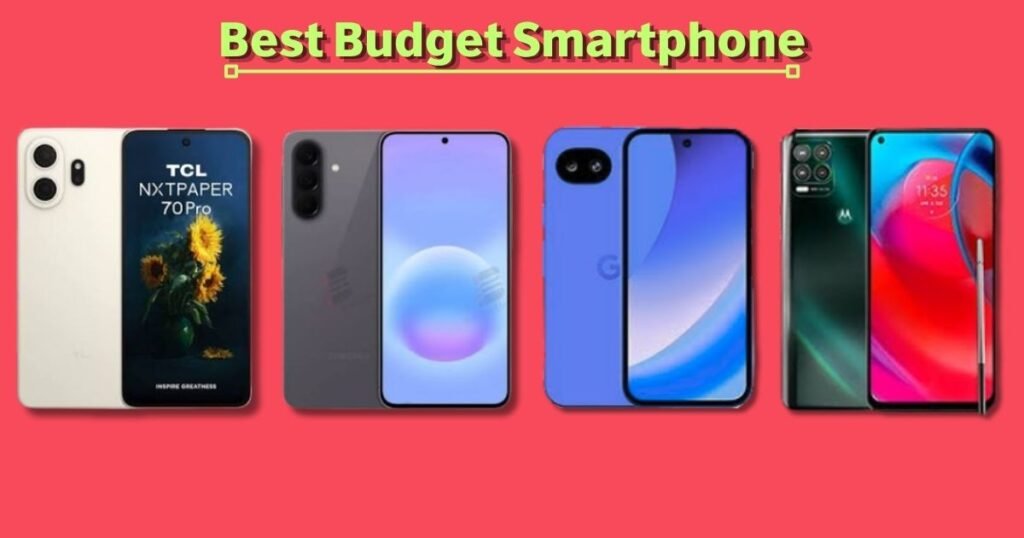
What Makes a Smartphone a Good Budget Buy in 2026?
Price and Overall Value
A phone’s sticker price only tells half the story. True value calculation factors in how many years the device will remain fast, secure, and usable. A $200 phone that stops receiving security patches after 18 months or slows to a crawl under basic multitasking is far more expensive in the long run than a $400 phone that performs smoothly for five years. When evaluating overall value, consider operating system update policies, build construction, and hardware longevity alongside the initial purchase cost.
Performance
In 2026, modern budget chipsets such as Google’s Tensor G4, Qualcomm’s Snapdragon 6 Series, MediaTek’s Dimensity chips, and Samsung’s Exynos silicon—deliver more than enough power for everyday tasks. System responsiveness relies heavily on a balance between the processor and system memory (RAM). For smooth app launches, web browsing with multiple open tabs, social media scrolling, and media streaming, 6GB to 8GB of RAM is the modern baseline. Devices with 4GB of RAM struggle when switching between heavy applications like navigation and camera software simultaneously.
Battery Life and Charging
Battery capacity in affordable smartphones typically ranges from 5,000 mAh to 5,200 mAh. Because budget processors are engineered for energy efficiency rather than extreme peak computing output, affordable phones frequently outlast high-end flagships in screen-on time. Look for real-world single-charge performance that easily carries through a full day of heavy usage. Charging speeds have also improved: baseline entry models support 25W to 30W wired charging, while upper-tier budget models offer fast 45W to 68W charging speeds and wireless charging support.
Display Quality
You interact with your phone’s display every single minute you use it. Fortunately, sharp OLED, pOLED, and Super AMOLED panels have largely replaced dull, low-contrast LCD screens in the sub-$500 category. Key display traits to look for include:
- Refresh Rate: 90Hz to 120Hz refresh rates make scrolling through feeds and animations look fluid.
- Peak Brightness: Outdoor visibility requires panels capable of reaching 800 to 2,000+ nits so the screen remains readable under direct sunlight.
- Eye Comfort & Tech: Innovations like matte anti-glare coatings reduce eye strain during long reading sessions.
Camera Quality
Megapixel counts can be deceiving. A 108MP image sensor paired with weak image processing algorithms will produce worse photos than a 48MP or 50MP main sensor paired with computational photography and Optical Image Stabilization (OIS).
- Main Camera: OIS is essential for reducing blur in handheld shots and low-light environments.
- Ultrawide & Secondary Lenses: Ultrawide cameras (8MP to 13MP) add versatility for group shots and landscapes. Beware of cheap 2MP macro filler lenses that add little practical photography value.
- Night & AI Processing: Software processing algorithms handle high dynamic range (HDR), color balancing, and low-light exposure far more than raw hardware alone.
Software and Security Updates
Software longevity is critical. Leading manufacturers like Google and Samsung now offer between 6 to 7 years of full operating system upgrades and security patches for select budget handsets. Longer support extended over multiple years ensures your banking apps, biometric security, and new software features remain fully functional over time.
Storage
App download sizes, system software, high-resolution media, and offline streaming downloads quickly consume local space. While 128GB of internal storage is standard for base models, power users, casual gamers, and parents taking frequent family videos will benefit from 256GB configurations or phones with expandable microSD card slots.
Durability
Accidents happen. Look for phones featuring Gorilla Glass screen protection (such as Victus or Gorilla Glass 7i) to prevent scratches and shatter damage. Pay attention to ingress protection (IP) ratings:
- IP54: Basic protection against light rain splashes and dust ingress.
- IP68 / IP69: High-tier dust tightness and full water submersion protection up to 1.5 meters.
READ MORE: Motorola vs Samsung (2026): Which Smartphone Brand Is Better for You?
Best Budget Smartphone 2026: Top 5 Affordable Phones
1. Google Pixel 10a
- Price: $499 (128GB) / $599 (256GB)
- Design & Display: 6.3″ 120Hz P-OLED (up to 3,000 nits peak), aluminum frame with matte plastic back, IP68 rated, Gorilla Glass 7i.
- Performance: Tensor G4 (4nm), 8GB RAM, Titan M2 security chip. Smooth daily use; weaker on intensive gaming.
- Cameras: 48MP main (OIS) + 13MP ultrawide; 13MP selfie (4K). Best-in-class computational photography and low-light performance.
- Battery & Power: 5,100 mAh (7–8 hrs screen-on time), 30W wired, 10W wireless, bypass charging.
- Software & Specs: Android 16, 7 years of OS/security updates, Wi-Fi 6E, Bluetooth 6.0, no 3.5mm jack, non-expandable UFS 3.1 storage.
- Verdict: Best Overall Value & Camera (Ideal for camera quality and long-term software support).
2. Samsung Galaxy A57 5G
- Price: $549.99 (8GB/128GB) (often on sale for $450–$499)
- Design & Display: 6.7″ 120Hz Super AMOLED+ (1,900 nits peak), premium slim (6.9mm) glass-and-aluminum build, Victus+, IP68 rated.
- Performance: Exynos 1680 (4nm), 8GB RAM, Xclipse 550 GPU. Fast navigation and steady mid-tier gaming.
- Cameras: 50MP main (OIS) + 12MP ultrawide + 5MP macro; 12MP selfie (4K). Vibrant, social-ready colors.
- Battery & Power: 5,000 mAh (1-day battery), 45W wired charging (0–70% in ~35 mins). No wall charger or wireless charging.
- Software & Specs: One UI 8 (Android 16), 6 years of OS/security updates, Knox Vault, non-expandable storage, no 3.5mm jack.
- Verdict: Best Premium Display & Hardware (Ideal for a sleek build, high-end screen, and fast charging).
3. TCL NXTPAPER 70 Pro
- Price: $349 (8GB/256GB)
- Design & Display: 6.8″ 120Hz NXTPAPER IPS display with nano-etched anti-glare, paper-like feel, and a physical switch for color/e-paper/ink modes. Smudge-resistant back.
- Performance: MediaTek Dimensity 6300, 8GB RAM, 256GB base storage. Reliable for daily tasks, e-books, and streaming.
- Cameras: 108MP main + 8MP ultrawide + 2MP macro; 32MP selfie. Detailed daylight shots; average in low light.
- Battery & Power: 5,010 mAh (up to 2 days of battery life), 33W wired charging.
- Software & Specs: Android (reading-optimized UI), 2 OS updates / 3 years security patches, 3.5mm jack, microSD expansion up to 2TB.
- Verdict: Best for Reading & Eye Comfort (Ideal for readers, students, and users prone to eye strain).
4. Samsung Galaxy A17 5G
- Price: $199.99 (6GB/128GB)
- Design & Display: 6.7″ 90Hz Super AMOLED (FHD+), Gorilla Glass Victus front, textured plastic frame, IP54 splash resistance.
- Performance: Exynos 1330, 6GB RAM. Handles daily tasks cleanly with minor stutters under heavy multitasking.
- Cameras: 50MP main (OIS) + 5MP ultrawide + 2MP macro; 13MP selfie. Great daytime clarity for sub-$200.
- Battery & Power: 5,000 mAh (up to 2-day battery life), 25W wired charging.
- Software & Specs: 6 years of OS updates, 3.5mm headphone jack, microSD expansion up to 1TB, side fingerprint sensor.
- Verdict: Best Ultra-Budget Option Under $200 (Ideal for kids, seniors, or basic needs on a budget).
5. Motorola Moto G Stylus 5G
- Price: $399.99 (8GB/256GB) (frequently $349)
- Design & Display: 6.7″ 120Hz pOLED (3,000 nits peak), vegan leather back, IP68 rated. Built-in passive stylus for notes and signing documents.
- Performance: Snapdragon 6 Gen 3, 8GB RAM, 256GB base storage. Smooth performance across apps and menus.
- Cameras: 50MP main (OIS) + 13MP ultrawide/macro; 32MP selfie (4K). Solid overall imaging.
- Battery & Power: 5,000 mAh (1.5 days), 68W wired (0–80% in ~25 mins), 15W wireless.
- Software & Specs: Android, 2 OS updates / 3 years security patches, Dolby Atmos stereo speakers, 3.5mm jack, microSD expansion up to 1TB.
- Verdict: Best for Stylus & Productivity (Ideal for note-takers, document signers, and fast-charging enthusiasts).
Detailed Side-by-Side Comparison Table
| Feature | Google Pixel 10a | Samsung Galaxy A57 5G | TCL NXTPAPER 70 Pro | Samsung Galaxy A17 5G | Moto G Stylus 5G |
| Approx. U.S. Price | $499 (128GB) / $599 (256GB) | $549.99 (Sale: ~$450-$499) | $349 (256GB) | $199.99 | $399.99 (Sale: ~$349) |
| RAM | 8GB | 8GB / 12GB | 8GB | 6GB / 8GB | 8GB |
| Storage | 128GB / 256GB | 128GB / 256GB | 256GB / 512GB | 128GB | 256GB |
| Processor | Google Tensor G4 | Exynos 1680 | MediaTek Dimensity 6300 | Exynos 1330 | Snapdragon 6 Gen 3 |
| Display | 6.3″ P-OLED (2424×1080) | 6.7″ Super AMOLED+ (2340×1080) | 6.8″ NXTPAPER IPS (2460×1080) | 6.7″ Super AMOLED (2340×1080) | 6.7″ pOLED (2712×1220) |
| Refresh Rate | 120Hz | 120Hz | 120Hz | 90Hz | 120Hz |
| Main Camera | 48MP (OIS, f/1.7) | 50MP (OIS, f/1.8) | 108MP (f/1.75) | 50MP (OIS, f/1.8) | 50MP (OIS, f/1.8) |
| Ultrawide Camera | 13MP (120°) | 12MP (123°) | 8MP (120°) | 5MP | 13MP (120°) |
| Front Camera | 13MP | 12MP | 32MP | 13MP | 32MP |
| Battery Capacity | 5,100 mAh | 5,000 mAh | 5,010 mAh | 5,000 mAh | 5,000 mAh |
| Wired Charging | 30W | 45W | 33W | 25W | 68W |
| 5G Support | Yes | Yes | Yes | Yes | Yes |
| IP Rating | IP68 | IP68 | Basic Splash | IP54 | IP68 |
| Wireless Charging | Yes (10W) | Not supported | Not supported | Not supported | Yes (15W) |
| Expandable Storage | Not supported | Not supported | Yes (microSD up to 2TB) | Yes (microSD up to 1TB) | Yes (microSD up to 1TB) |
| Headphone Jack | Not supported | Not supported | Yes (3.5mm) | Yes (3.5mm) | Yes (3.5mm) |
| Software Support | 7 Years (OS & Security) | 6 Years (OS & Security) | 2 OS Upgrades / 3 Yrs Security | 6 Years OS Upgrades | 2 OS Upgrades / 3 Yrs Security |
| Best For | Camera & Long Updates | Premium Build & Display | Reading & Eye Comfort | Entry-Level Under $200 | Stylus & Rapid Charging |
Which Is the Best Budget Smartphone 2026?
Determining the single best budget smartphone depends on what features matter most to you. Here is how the top contenders rank across key priorities:
- Best Overall Budget Smartphone: Google Pixel 10a
Reasoning: The Pixel 10a delivers an ideal balance of computational camera performance, reliable hardware construction (IP68), clean software features, and an industry-leading 7-year update policy. For most buyers, this model represents the smartest long-term investment under $500. - Best Hardware & Display Experience: Samsung Galaxy A57 5G
Reasoning: If you want a phone that looks and feels like a $1,000 flagship, the A57’s metal frame, glass back, vibrant Super AMOLED+ display, and 45W charging make it the standout hardware choice in the upper-budget range. - Best for Reading & Screen Comfort: TCL NXTPAPER 70 Pro
Reasoning: No other smartphone eliminates glare and eye fatigue like TCL’s NXTPAPER tech. Paired with 256GB baseline storage and dedicated e-paper reading modes, it is a specialized win for book lovers and document reviewers. - Best Productivity & Feature Set: Motorola Moto G Stylus 5G
Reasoning: Motorola packages a bright 120Hz pOLED screen, 68W fast charging, 15W wireless charging, 256GB of storage, expandable memory, a 3.5mm headphone jack, and an integrated stylus into a versatile sub-$400 phone. - Best Tight-Budget Option: Samsung Galaxy A17 5G
Reasoning: For buyers who need to stay under $200, the Galaxy A17 5G offers a 90Hz AMOLED display, a 50MP OIS camera, and multi-year software updates without requiring major trade-offs.
How Much Should You Spend on a Budget Smartphone?
Understanding price tiers helps align your budget with realistic hardware expectations:
- Under $200 (Entry Budget): Expect basic plastic builds, 90Hz AMOLED screens, standard camera setups, and 25W charging. Perfect for secondary lines, kids, or light users. (Example: Samsung Galaxy A17 5G)
- $200 – $350 (Core Value Tier): Adds 120Hz display refresh rates, higher baseline storage (256GB), anti-glare display tech, or built-in stylus hardware. (Example: TCL NXTPAPER 70 Pro)
- $350 – $500 (Upper Budget / Value Champion): Unlocks flagship-grade camera sensors, IP68 water resistance ratings, rapid 68W charging, wireless charging, and 7-year OS update commitments. (Examples: Google Pixel 10a, Moto G Stylus 5G)
- $500 – $600 (Midrange Crossover): Brings premium glass-and-aluminum designs, 45W charging speeds, and refined display brightness. (Example: Samsung Galaxy A57 5G)
Price Ranges & Expectations:
- Sub-$200: Essential Connectivity & Long Updates
- $200-$350: 120Hz Displays & Specialized Features (Stylus/NXTPAPER)
- $350-$500: Flagship Cameras, IP68 Protection & 7-Year OS Support
Buying Tips & Carrier Deals:
- MSRP vs. Sale Pricing: Budget phones go on sale frequently during major retail holiday windows. Older models can often be bought at discounts of $50 to $100 off MSRP.
- Carrier Promotions: While carriers often advertise phones as “free” with bill credits, check for mandatory 36-month service commitments or high-tier unlimited plan requirements. Buying an unlocked phone outright often saves money over time by giving you the freedom to choose lower-cost MVNO prepaid plans.
- Refurbished Flagships: Factory-certified refurbished flagships from previous generations can offer strong camera hardware, though they come with shorter remaining software support lifecycles than new budget models.
What Should You Look for When Buying a Budget Smartphone?
Use this practical buyer’s checklist before placing your order:
- Processor & RAM: Aim for an octa-core processor paired with a minimum of 6GB to 8GB of RAM to ensure smooth multitasking performance.
- Storage Capacity: Select 128GB if you primarily stream media, or 256GB if you capture high-resolution photos and video locally. Verify if the device includes a microSD slot if expansion matters to you.
- Display Quality: Prioritize OLED/AMOLED display panels with 90Hz or 120Hz refresh rates for vivid colors and smooth scrolling.
- Camera Capabilities: Look for Optical Image Stabilization (OIS) on the main camera sensor to reduce blur in low-light environments.
- Battery & Charging: Look for a minimum 5,000 mAh battery capacity paired with at least 25W to 68W wired fast charging.
- Software Updates: Check for official commitments of at least 3 to 7 years of OS and security updates.
- Durability: Confirm Corning Gorilla Glass screen protection and check for IP54 splash protection or IP68 full water submersion resistance.
- Connectivity Essentials: Verify 5G capability, NFC support for mobile payment apps, USB-C ports, and dual-SIM/eSIM options.
Common Mistakes to Avoid When Buying a Cheap Smartphone
- Buying Based Only on Megapixel Numbers: High megapixel counts (e.g., 108MP) do not automatically guarantee superior picture quality. Sensor size, lens quality, and software image processing algorithms play a much larger role in photo performance.
- Choosing Too Little Memory (RAM): Purchasing a smartphone with only 4GB of RAM in 2026 will cause app reload lag, browser crashes, and system stutter under daily use. Stick to 6GB or 8GB minimum.
- Ignoring Software Upgrade Commitments: Buying a cheap phone that receives no Android OS updates leaves your personal device vulnerable to security exploits and cuts off new features after a few months.
- Overlooking U.S. Network Band Compatibility: Importing an international phone model can lead to missing LTE and 5G network bands used by U.S. carriers (AT&T, T-Mobile, Verizon), resulting in poor coverage and dropped calls. Always confirm full U.S. network band compatibility.
- Ignoring Display Brightness Specs: A display with low peak outdoor brightness will be difficult to view under sunlight. Look for peak brightness ratings of 800 to 1,500+ nits.
Budget Smartphone vs. Refurbished Flagship: Which Is Better?
When shopping under $500, consumers often compare a brand-new budget smartphone against an older, refurbished flagship device. Here is how the trade-offs break down:
| Feature | New Budget Smartphone (2026) | Refurbished Older Flagship |
| Battery Health | 100% fresh battery capacity out of the box | Chemically degraded battery (typically 80-90% health) |
| Software Support | 4 to 7 full years of future Android OS upgrades | Often near the end of official update lifecycles |
| Warranty Coverage | Full 1-year manufacturer warranty included | Limited 30 to 90-day seller warranty |
| Camera Hardware | Modern computational AI processing | Dedicated telephoto zoom lenses |
| Build Materials | Plastic frames or refined glass/metal | Premium glass, metal, and titanium builds |
The Bottom Line: Choose a new budget smartphone if you prioritize fresh battery performance, manufacturer warranty coverage, modern network support, and up to 7 years of software security updates. Choose a refurbished flagship if your primary goal is specialized hardware like dedicated optical zoom lenses or ultra-premium chassis materials.
Frequently Asked Questions About Budget Smartphones
What is the best budget smartphone in 2026?
The Google Pixel 10a is widely considered the best overall budget smartphone in 2026. It combines flagship-grade computational photography, a 120Hz OLED screen, an IP68 water resistance rating, Google’s Tensor G4 processor, and an industry-leading 7 years of software and security updates.
Which is the best cheap Android phone in 2026?
The Samsung Galaxy A17 5G is the top option for buyers looking for a cheap Android phone under $200. It features a 6.7-inch Super AMOLED screen with a 90Hz refresh rate, a 50MP main camera with Optical Image Stabilization (OIS), a 5,000 mAh battery, expandable storage via microSD, and up to 6 major Android OS upgrades.
What is the best smartphone under $500 in 2026?
Under $500, the top choices are the Google Pixel 10a ($499) and the Motorola Moto G Stylus 5G ($399). The Pixel 10a excels at photography, software updates, and water resistance. The Moto G Stylus 5G offers an integrated stylus pen, a 6.7-inch 120Hz pOLED screen, 256GB baseline storage, 68W fast wired charging, and wireless charging support.
Which budget phone has the best camera in 2026?
The Google Pixel 10a features the best overall camera system in the budget phone category. Its 48MP main sensor (with OIS) and 13MP ultrawide lens leverage Google’s computational photography algorithms to deliver low-light performance, natural skin tones, clear portrait shots, and wide dynamic range that outperform hardware rivals.
How much should I spend on a budget smartphone in 2026?
Most consumers should aim to spend between $200 and $450 for an ideal balance of performance, display quality, and durability. Spending under $200 gets you basic functionality and long updates, while spending $350 to $499 unlocks 120Hz OLED displays, IP68 water resistance, fast charging, high storage configurations, and 6 to 7 years of software update support.
